
Friday, June 22, 2012

Tuesday, May 22, 2012
Andrés Galeano: Off the ground, lightly
PRESUME, group show at Kunstraum Kreuzberg, Bethanien
the Mart Stam Prize
Curator: Kornelia von Berswordt-Wallrabe
4 - 20 May 2012
“Part of my artistic research is concerned with the myth of flying and the archetypal figure of the human-bird, and their array of depictions across cultures.” (Andrés Galeano)¹
I must confess: having seen Andrés Galeano performing at the Savvy Contemporary gallery in November 2011 (check Co-Lab Editions 5) made me familiar with his interest in the theme of flight and his sophisticated, unobtrusive and fresh way of working with ideas, images, objects and his own body.
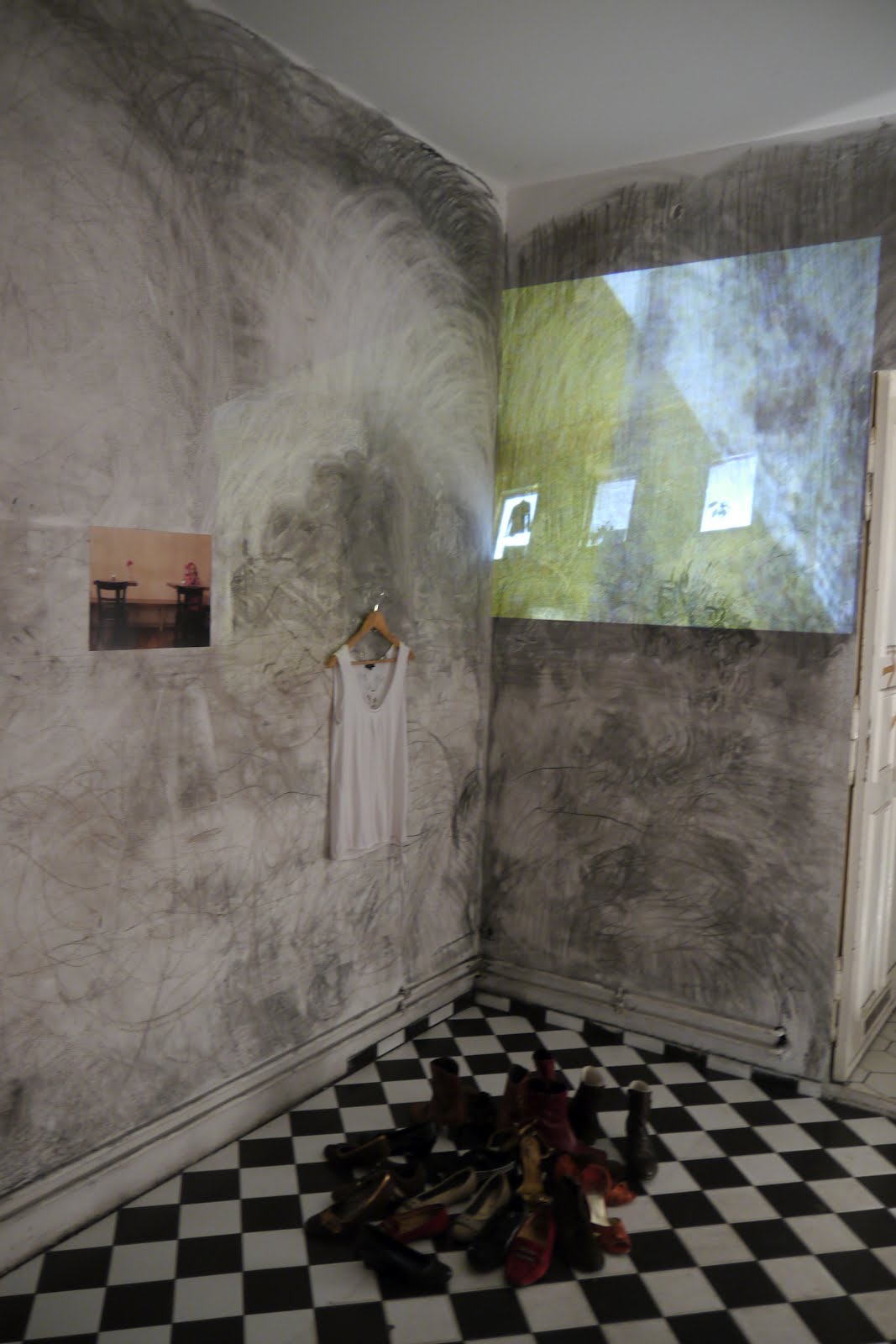
Andrés Galeano´s presentation for the PRESUME group show at Kunstraum Kreuzberg (Bethanien) consists of different parts: two performance videos, a dia-projection, a series of three framed photographs (Zero Gravity, 2012) and a single, bigger photo printed on paper hanging next to the projection wall (Unknown Photographers #2).
The video-performance El Canto del Harzer Roller (The Singing of the Harzer Roller canary, 2011) shows the artist imitating the chirping of a harzer roller canary, as the title says. This effect is obtained by showing the filmed material in speed-up mode and having it play almost in a loop. The artist's performance plays upon the tradition of the pajareros who catch such birds in order to cultivate their special singing and organise singing competitions. Andrés' yellow sweater worn during the performance also conveys a note of humour to the piece, reminding you of Tweety, the animated canary. A witty and playful way of reflecting upon the interaction between animals and humans, nature and imitation, as well as questioning the sometimes cruel connection between freedom and aesthetics.
His interest for man´s desire to lift himself off the ground is further explored in the dia-projection. Air-planes, snowy peaks and abrupt cliffs, cloud-stalking skyscrapers, amusement parks and roller-coasters, warmth-filled balloons, monuments targeting the skyline, parks, temples, graffiti walls, all of these and some more make up the various settings in his photos, filled with life, human presence and spirit: trees, children raising kites, tourists, mountain climbers and dancers, contenders, families and loners (Einzelgängers), birds, pyramids and Renaissance Madonnas.
Reminding me of another one of his works, Montages, (2011)², the present dia-projection also works by accumulation, selection and associations. Andrés Galeano´s selected images communicate and travel across cultures. The photos he uses this time are all found, whereby the name Unknown Photographers. Some have an artistic touch to them, others are simply holiday pictures each of us makes on different occasions; some are technically correct, while others are unfocused.
Spatially, the dia-show is framed by the video of Andrés Galeano´s Cue & Review performance and by an enlarged, colour photograph: Man on a ladder I like to call it. Its actual title is Unknown Photographers #2, the image being taken from a found photo album. What you actually see is a man on a ladder, his back turned to the viewer, climbed on a living gate. There are flowers in the foreground and a house can be spotted through the opening of the living, green gate. The image could have been taken in a park, or maybe in the garden of a palace. The man on the ladder wearing plastic boots, his head a bit bent could be a gardener, trimming the grass. Due to a voluntary gesture or to a technical mistake the upper left side of the image, right where the man's body towers over the ladder, appears over-exposed, burnt. In terms of colour and composition, the rising, golden-looking human figure corresponds to the iridescent, unfocused white mass of flowers at the bottom of the photo.

Photographers #2, variable size, 2012
For a certain reason, the artist chose to enlarge this particular photo from his series of found images with unknown photographers. This is an almost domestic setting, there is nothing heroic about the man on the ladder. Except that, quite unaware of the fact himself, he seems to be in a different space. It looks as if the moment he takes even a little bit off the ground, man is in a different sphere, a magical one. An enlightened one, like the photograph playfully reveals.
All together, the artist's image collection reveals man's almost everyday engagement with the idea of flying, our manifold pursuit of leaving the ground for a short while and enjoying the world from a different perspective (be it a mountain top, a church or a dancer's stage). The beauty of these photos coming together lies in the fact that the artist does not discriminate between them, which doesn't mean he doesn't select. All pictures used by Galeano, independent of their provenance and looks, are eloquent testimonies of our desire to inhabit the air for a while.
And if the human body cannot always take off, the gaze can do it: in one of the projected photos a man lies on a meadow and looks up at the sky. The landscape surrounding him is completely flat, but nevertheless, his motionless act of looking draws out a vertical movement, an invisible gesture of leaving the ground, a momentary loss of gravity. This seems to be one of sight´s most precious gifts: its weightless, its lightness of being, its freedom to roam and discover.
This takes me to the second one of Galeano´s performances, Cue & Review (25 min., 2011) which was running on the lateral wall, close to the dia-projection. One of the moments that stayed with me after I left the exhibition was when the artist picks up a red apple, throws it in the air and lets it fall on his head. An unexpected, ironic gesture. A self-inflected pain aimed at calling out the wings of inspiration? After being hit by the apple Galeano opens a can of Red Bull and starts to drink, maybe in the hope of growing wings. A clin d'œil at advertising’s appropriation of Icarus' myth of flight? Apples and flight, inseparable from gravity and falling: Newton, inspiration and Eve´s promise of knowledge. And a light sense of humour which gently emerges from his thoroughly choreographed performance. It is a show carried out with gentleness and diligence, without any trace of ostentation.
There is also an element of surprise in Galeano's work. You experience it while watching his collections of juxtaposed images, be it a visual collage or a dia-projection; you also discover it in moments like his throwing of the apple which will hit him on the head the next moment. This surprising effect belongs to a view upon the world which, beyond being insightful and elaborate, remains curious and fresh.
Some of the key-objects Galeano used in his 2011 performance re-appear now in a different form and format: a green apple, a hammer and a feather show up as photos, all of them on black background (Zero Gravity, 2012). In a way, by becoming images, the objects loose their weight; they also loose context, which turns them into symbols and triggers a whole flow of associations and cultural references (the apple: Eve, knowledge, food... for thought, the Fall from Paradise, Newton´s gravity; the hammer: destruction, breaking and fixing, fragility; the feather: flight, writing, lightness). This loosing of context also puts the chosen objects out of function. By being photographed and displayed as photos, all three objects, as different as they are in their usage, powers and substance, become more alike: now they all share a neuter space and a state of levitation.

The triptych is a visual meditation on the interplay between knowledge, power and art and, in the light of Galeano's performance Cut & Review, on the juxtaposition between objects, actions and words in the flow of our life, in our various and repeated attempts at flying.
Zero Gravity, 2012
Notes:
2 “Montages is a photographic series-in-progress that creates surprising juxtapositions of found photographs that touch on the primordial desire to fly.” Andrés Galeano: http://www.andresgaleano.eu/page6/page65/page65.html

Andrés Galeano: Off the ground, lightly by Ioana Muntenescu is licensed under a Creative Commons Attribution-NonCommercial-NoDerivs 3.0 Germany License.
Tuesday, May 1, 2012
Three Ideas in One
Review: Three Ideas in One
A SAVVY Contemporary Performance at AAA (Abteilung für Alles Andere) by Christian Burnoski (USA) and Andrea Jenni (CH)
Friday, 27 March 2012
The performance lasted about ten minutes. This text will take you less than five minutes to read. How long does it take to look at a painting? How long did it take Christain Burnoski and Andrea Jenni to look at a particular photograph by Ludwig Windstosser and get inspired by it?
It was dark when we entered the room and found our way to the improvised seats: e bench, some hard carton boxes, pillows lying on the floor. Then our eyes accommodated themselves to the environment. There was some dim light inside coming from a green-orange lamp on the stage, where one could also distinguish some blue paintings and two more lamps hanging low, close to the floor. And a woman's silhouette, back turned to the public, arranging her long hair.

Two more women appeared and went to the red wall, always with their back towards the viewer. When the music started they began to move and slowly approach the public without turning their face towards us. When it finally happened, we could see their colourful, glowing disco-pop make-up and their 80´s outfits. The music was also disco-like, the girls seemed to have a kind of a party.


The performance had a changing rhythm and also played with interruptions, moments when the music would stop and the girls would frieze in a certain pose, then repeat the same pose about three times in a row. Throughout the performance the girls´ movements varied from fluid, disco-like, to more linear, making me think of lines in an abstract painting. But I guess my association was triggered primarily not by their dancing, but by the blue painting on the right wall. By the overall setting of the room: a red wall, a blue canvas, an orange-green lamp. Just like in Windstosser´s image. One should not forget what one knew before attending the performance: namely that the piece is inspired by a photograph. This was the context set for our perception of the show, and the décor made you feel as if you were inside a painting. With moving figures, with music and energy filling the frame.
And this is where the performance reveals its challenge: in showing the interplay between stillness, characteristic to two-dimensional images such as paintings and photographs, and movement, between abstraction and dancing, between flatness and perspective. The artists' endeavour becomes one of translating a photograph (Windstosser's) into a performance.
Three Ideas in One can also be viewed as a variation on the theme of keeping still, with the three female dancers alternately embodying sitting, standing and lying down. Paradoxically, these forms of stillness prove to be necessary and inspiring phases in a complex process of transition and movement from numbness to dance, from passive to expressive. Another significant detail: when the piece started the performers had their backs turned to the audience; when they ended the show, they were standing, facing us. A decisive moment, when their gaze expanded the frames of the performance and the canvas-like stage opened up to the viewers...

Text and performance stills: Ioana Muntenescu
Three Ideas in One by Ioana Muntenescu is licensed under a Creative Commons Attribution-NonCommercial-NoDerivs 3.0 Germany License.
A SAVVY Contemporary Performance at AAA (Abteilung für Alles Andere) by Christian Burnoski (USA) and Andrea Jenni (CH)
Friday, 27 March 2012
The performance lasted about ten minutes. This text will take you less than five minutes to read. How long does it take to look at a painting? How long did it take Christain Burnoski and Andrea Jenni to look at a particular photograph by Ludwig Windstosser and get inspired by it?
It was dark when we entered the room and found our way to the improvised seats: e bench, some hard carton boxes, pillows lying on the floor. Then our eyes accommodated themselves to the environment. There was some dim light inside coming from a green-orange lamp on the stage, where one could also distinguish some blue paintings and two more lamps hanging low, close to the floor. And a woman's silhouette, back turned to the public, arranging her long hair.

Two more women appeared and went to the red wall, always with their back towards the viewer. When the music started they began to move and slowly approach the public without turning their face towards us. When it finally happened, we could see their colourful, glowing disco-pop make-up and their 80´s outfits. The music was also disco-like, the girls seemed to have a kind of a party.


The performance had a changing rhythm and also played with interruptions, moments when the music would stop and the girls would frieze in a certain pose, then repeat the same pose about three times in a row. Throughout the performance the girls´ movements varied from fluid, disco-like, to more linear, making me think of lines in an abstract painting. But I guess my association was triggered primarily not by their dancing, but by the blue painting on the right wall. By the overall setting of the room: a red wall, a blue canvas, an orange-green lamp. Just like in Windstosser´s image. One should not forget what one knew before attending the performance: namely that the piece is inspired by a photograph. This was the context set for our perception of the show, and the décor made you feel as if you were inside a painting. With moving figures, with music and energy filling the frame.
And this is where the performance reveals its challenge: in showing the interplay between stillness, characteristic to two-dimensional images such as paintings and photographs, and movement, between abstraction and dancing, between flatness and perspective. The artists' endeavour becomes one of translating a photograph (Windstosser's) into a performance.
Three Ideas in One can also be viewed as a variation on the theme of keeping still, with the three female dancers alternately embodying sitting, standing and lying down. Paradoxically, these forms of stillness prove to be necessary and inspiring phases in a complex process of transition and movement from numbness to dance, from passive to expressive. Another significant detail: when the piece started the performers had their backs turned to the audience; when they ended the show, they were standing, facing us. A decisive moment, when their gaze expanded the frames of the performance and the canvas-like stage opened up to the viewers...

Text and performance stills: Ioana Muntenescu
Three Ideas in One by Ioana Muntenescu is licensed under a Creative Commons Attribution-NonCommercial-NoDerivs 3.0 Germany License.
Thursday, March 29, 2012
.JPG)
Wednesday, February 15, 2012
Wonderlust. Overview
Photography and an attempt at installation

Walking through the world with the desire to see and to marvel. Photos as traces of our journeys. As muses for the road to come...
Walking: could be a dance, a dream, a game or a journey. An initiation, an invitation. We step in and out of our routines, we follow decisions, we look for adventures. And learning how to leave traces (behind and ahead of us) is part of the game.


Visitors during the show

Visitor during the show


Photos by Nikhil Chopra, 28 January 2012
Final Presentation for "The Visual in the Performative" Workshop run by Nikhil Chopra, Madhavi Gore, Tina Lange
http://www.nikhilchopra.net/

Walking through the world with the desire to see and to marvel. Photos as traces of our journeys. As muses for the road to come...
Walking: could be a dance, a dream, a game or a journey. An initiation, an invitation. We step in and out of our routines, we follow decisions, we look for adventures. And learning how to leave traces (behind and ahead of us) is part of the game.


Visitors during the show

Visitor during the show

Photos by Nikhil Chopra, 28 January 2012
Final Presentation for "The Visual in the Performative" Workshop run by Nikhil Chopra, Madhavi Gore, Tina Lange
http://www.nikhilchopra.net/
Tuesday, February 14, 2012


Wonderlust. The photo projection


These images were projected on the wall as part of my "Wonderlust" project
Tuesday, December 27, 2011
CO-LAB Editions 5 with Andrés Galeano and Maurice Block
Co-Lab Editions 5: Andrés Galeano (ESP/DE) and Maurice Block (NL/FIN) performing at SAVVY Contemporary
Curator: Marcio Carvalho
Sunday, the 6th of November 2011
Co-Lab Editions No. 5 brought together two performance artists whose different approaches created a space for intellectual dialogue and artistic collaboration. Throughout their performance Andrés Galeano and Maurice Block explored the theme of flight and its potential meanings and usages: the ideal of leaving the ground, the consciousness of falling, and the poetics and politics at stake when seeing the world from above.
Andrés Galeano explored and displayed the transformations and variations taken by a particular shape, specifically a cone-shaped paper form used for drinking water. Galeano's performance dealt with this form through a collection of images, playing with their placement and selection. Visual associations, mixed with the artist's precise selection of material are offered to the public as modes of contemplation.
In contrast to the more subtle nuances of Galeano's images, Maurice Block's performance sought out a more straight forward, unmediated contact within the same theme. The artist's use of both his own physicality and the limited physicality of objects lent a sense of risk and humour to the evening. Block reminded us that one has to embrace falling, breaking, and failing when fully exploring themes of flying.
The performance also played with recording and documenting in real time. A small video camera acted as an umbilical chord between the two artists and allowed the viewer to follow their actions without necessarily being in the same room with them. A sense of connection and at the same time, a meditation upon the processes involved were taking shape.
To view the online collaboration between the 2 artists, please follow the link:
http://co-labeditions5.blogspot.com/
Curator: Marcio Carvalho
Sunday, the 6th of November 2011
Co-Lab Editions No. 5 brought together two performance artists whose different approaches created a space for intellectual dialogue and artistic collaboration. Throughout their performance Andrés Galeano and Maurice Block explored the theme of flight and its potential meanings and usages: the ideal of leaving the ground, the consciousness of falling, and the poetics and politics at stake when seeing the world from above.
Andrés Galeano explored and displayed the transformations and variations taken by a particular shape, specifically a cone-shaped paper form used for drinking water. Galeano's performance dealt with this form through a collection of images, playing with their placement and selection. Visual associations, mixed with the artist's precise selection of material are offered to the public as modes of contemplation.
In contrast to the more subtle nuances of Galeano's images, Maurice Block's performance sought out a more straight forward, unmediated contact within the same theme. The artist's use of both his own physicality and the limited physicality of objects lent a sense of risk and humour to the evening. Block reminded us that one has to embrace falling, breaking, and failing when fully exploring themes of flying.
The performance also played with recording and documenting in real time. A small video camera acted as an umbilical chord between the two artists and allowed the viewer to follow their actions without necessarily being in the same room with them. A sense of connection and at the same time, a meditation upon the processes involved were taking shape.
To view the online collaboration between the 2 artists, please follow the link:
http://co-labeditions5.blogspot.com/
Thursday, November 17, 2011
Fall to Call with Alastair McLennan and Essi Kausaleinen
Co-Lab Editions No.4
Curator: Marcio Carvalho
Sunday, the 9th of October 2011
"Time we have is not so vital as time we make" (Alastair MacLennan in Rain, Rein, Reign)
Through their collaborative performance Alastair MacLennan and Essi Kausaleinen brought in a different pace of walking, of touching things around them, of breathing and thinking about the place and the time they spent there. Bringing installation art and performance together, using a rhythm reminiscent of rituals and a patience dilating not only time but also space, Essi Kausaleinen and Alastair MacLennan's Fall to Call created a fruitful harvest time.
MacLennan and Kausaleinen first met in Berlin where they began their collaboration. They wanted to meet each other in a free state of mind, to bring with them no expectations about the place or about each other. They wanted to discover common ground and common ideas at the actual place, together, without any kind of previous mediation. It's what they call “actuality”, being present in a specific place, dealing with the here and now, sharing time and space, and developing trust. Both artists move within the field of visual poetics, where words are not necessary to establish communication and spaces, regardless of size, begin to function as landscapes. They believe in the power of details, their artistic interventions are gentle, almost economical, yet at the same time radical.


While in Berlin, they also chose not to share images taken during their trips to the Botanical Garden on the Co-Lab-Editions website. For some previous Co-Lab-Editions partnerships it was essential that the artists’ collaboration was made public along the way. This time, the documentation of Essi Kausaleinen and Alastair MacLennan’s work would come to light only after their performance, not before it.
Working in the Botanical Garden Essi and Alastair shared time and space together in a process of looking for inspiration. And their performance at SAVVY was, according to their own words, a process of “sharing creation” with the public.

To find out more about the performance please also have a look here:
http://colabeditions4.blogspot.com/
Curator: Marcio Carvalho
Sunday, the 9th of October 2011
"Time we have is not so vital as time we make" (Alastair MacLennan in Rain, Rein, Reign)
Through their collaborative performance Alastair MacLennan and Essi Kausaleinen brought in a different pace of walking, of touching things around them, of breathing and thinking about the place and the time they spent there. Bringing installation art and performance together, using a rhythm reminiscent of rituals and a patience dilating not only time but also space, Essi Kausaleinen and Alastair MacLennan's Fall to Call created a fruitful harvest time.
MacLennan and Kausaleinen first met in Berlin where they began their collaboration. They wanted to meet each other in a free state of mind, to bring with them no expectations about the place or about each other. They wanted to discover common ground and common ideas at the actual place, together, without any kind of previous mediation. It's what they call “actuality”, being present in a specific place, dealing with the here and now, sharing time and space, and developing trust. Both artists move within the field of visual poetics, where words are not necessary to establish communication and spaces, regardless of size, begin to function as landscapes. They believe in the power of details, their artistic interventions are gentle, almost economical, yet at the same time radical.


While in Berlin, they also chose not to share images taken during their trips to the Botanical Garden on the Co-Lab-Editions website. For some previous Co-Lab-Editions partnerships it was essential that the artists’ collaboration was made public along the way. This time, the documentation of Essi Kausaleinen and Alastair MacLennan’s work would come to light only after their performance, not before it.
Working in the Botanical Garden Essi and Alastair shared time and space together in a process of looking for inspiration. And their performance at SAVVY was, according to their own words, a process of “sharing creation” with the public.

To find out more about the performance please also have a look here:
http://colabeditions4.blogspot.com/
Friday, October 28, 2011
Dance at SAVVY Contemporary
Dance Performance by Henrik Kaalund and Team
Curators: Cilgia Gadola and Raisa Kröger
1st of October 2011
On Saturday the SAVVY gallery once again animated our weekend in a very intense way. The Finissage of the GhostBusters exhibition was paired with a dance performance. A group of no more than seven dancers choreographed by Henrik Kaalund filled the space of the gallery and made the air vibrate with their energetic movements. The dance was based on the performers' attention and strong physical response to each other and to the change of sound during their action.
The dramaturgy and choreography of the show were very engaging for the public, right from the very beginning: it was fun to watch the dancers change turns in conducting their colleagues' gestures and movements. The dynamics of the whole piece were based on having each dancer enter the role of conductor/leader at one moment and then leaving it for somebody else to take over. It was a game which displayed not necessarily power relations, but rather the tension, alternation and playfulness involved in group communication. There was a particular scene which focused on the group's reactions to specific gestures and to various "leading" temperaments portrayed during the dancing. The public was also invited to join in the game at a certain moment, to become mobile and experience how it is to move according to somebody else's instructions. To read these instructions also.
The performance was funny, involving, sensitive.
During the last part of it recorded sound gave way to live singing, and the voice of a dancer accompanied her colleagues while they were resuming their performance in the narrow corridor. The minimal lightning built a charged and intimate atmosphere: members of the public were handed in a small lantern to hold during the dancing; at specific moments, the dancers who were keeping still would put the spotlight on their performing colleague.
In the context of this performance, contact dancing didn't mean dancers reacting to touch and physical contact only, but also to different kinds of sound. These varied from simple vocal signals that brought in alternation to different rhythms that switched the dancing pace completely. This alternation between soft and sportly, between group- and solo-dances, between speed and slow motion also made us wonder about the secret ingredients of the performance: improvisation and planning. A question we were glad to entertain at Savvy and then take home with us.


Practicing before the dance-performance
Curators: Cilgia Gadola and Raisa Kröger
1st of October 2011
On Saturday the SAVVY gallery once again animated our weekend in a very intense way. The Finissage of the GhostBusters exhibition was paired with a dance performance. A group of no more than seven dancers choreographed by Henrik Kaalund filled the space of the gallery and made the air vibrate with their energetic movements. The dance was based on the performers' attention and strong physical response to each other and to the change of sound during their action.
The dramaturgy and choreography of the show were very engaging for the public, right from the very beginning: it was fun to watch the dancers change turns in conducting their colleagues' gestures and movements. The dynamics of the whole piece were based on having each dancer enter the role of conductor/leader at one moment and then leaving it for somebody else to take over. It was a game which displayed not necessarily power relations, but rather the tension, alternation and playfulness involved in group communication. There was a particular scene which focused on the group's reactions to specific gestures and to various "leading" temperaments portrayed during the dancing. The public was also invited to join in the game at a certain moment, to become mobile and experience how it is to move according to somebody else's instructions. To read these instructions also.
The performance was funny, involving, sensitive.
During the last part of it recorded sound gave way to live singing, and the voice of a dancer accompanied her colleagues while they were resuming their performance in the narrow corridor. The minimal lightning built a charged and intimate atmosphere: members of the public were handed in a small lantern to hold during the dancing; at specific moments, the dancers who were keeping still would put the spotlight on their performing colleague.
In the context of this performance, contact dancing didn't mean dancers reacting to touch and physical contact only, but also to different kinds of sound. These varied from simple vocal signals that brought in alternation to different rhythms that switched the dancing pace completely. This alternation between soft and sportly, between group- and solo-dances, between speed and slow motion also made us wonder about the secret ingredients of the performance: improvisation and planning. A question we were glad to entertain at Savvy and then take home with us.


Practicing before the dance-performance
Monday, October 24, 2011
Video-sound-voice Performance at SAVVY Contemporary
Balz Isler at the SAVVY Contemporary Gallery
Saturday, the 15th of October 2011
Curators: Cilgia Gadola and Raisa Kröger

The setting was rather pop: a neon light was hanging vertically from the ceiling and resting on the floor. On one wall there's a big poster-like image of the artist himself photographed in front of a photo of some overgrown vegetables (if I got this one right); the artist's eyes are covered by tape, so you can only watch his colourful outfit next to huge tomatoes (or the like). On the opposite wall there is a huge, cheap but golden looking necklace; the pendant has the word "sex" written on it. A glass or plastic frame has been placed in front of the necklace, turning the whole thing into a painting-like object of contemplation. Irony, playfulness, kitsch... you name it!

In the next room a 10 Euro bill has been stuck into the wall. Behind a glass frame, placed on a golden background there is an army suit which bears the labels "facebook" and "twitter" on it. The ghost of a soldier of everyday routine and conquered friendships...

Two small plastic rabbits placed on pedestals (one black and one white) are engaged in conversation.
A white wooden frame houses a small video.
The smallest room in the gallery has the word "Machthaber" (the one who has power) hanging from the ceiling.
This is just to let you picture the setting and my expectations about Balz Isler's performance to come. I thought it's going to be critical, political, kitschy, superficial, even not comprehensible...
I didn't expect it to be poetical and intimate.
Balz Isler stood on a chair in the corner of the room, laptop in his lap. People were sitting on the floor, their gazes pointed towards the screen. He made a short introduction, then proceeded to screen several very short videos. Sound-videos. He superimposed them, layered their images and their sounds on the screen. He sang accompanying the videos (with a high, soft voice from the 80`s), and he accompanied his spoken words with the projection of short word definitions from a dictionary. At the end he literally said "sorry" and "thanks"...
The atmosphere was cosy, with a hint of self consciousness and fun in the background that weren't disturbing.
At a certain moment his singing got accompanied by a woman's voice from the public (his performance partner) and that was, besides his own voice, another live surprise that added warmth to this edited and well-commanded piece of video& sound installation.

The intro I mentioned he made at the beginning brought in the question of genuine experience when you know somebody else has seen or been to the same place as you. Despite this announced danger of not being able to enjoy something on your own because of the influences of previous accounts about "the same" experience, the audience shared the sound of a fire camp
the squeaking of a gate
the rhythm build out of several audio-cuts
an African landscape (that's what it looked like to me)
the flying above ground and the abrupt landing
a beautiful woman talking (maybe a conversation between friends, artists or/and lovers)
and a few more images and sounds...

During the screening the images would travel from the projector, meet the chord of the thin neon in the middle of the room and make it flickr. A bit of a magic was in the air...
Link to savvy contemporary
Saturday, the 15th of October 2011
Curators: Cilgia Gadola and Raisa Kröger

The setting was rather pop: a neon light was hanging vertically from the ceiling and resting on the floor. On one wall there's a big poster-like image of the artist himself photographed in front of a photo of some overgrown vegetables (if I got this one right); the artist's eyes are covered by tape, so you can only watch his colourful outfit next to huge tomatoes (or the like). On the opposite wall there is a huge, cheap but golden looking necklace; the pendant has the word "sex" written on it. A glass or plastic frame has been placed in front of the necklace, turning the whole thing into a painting-like object of contemplation. Irony, playfulness, kitsch... you name it!

In the next room a 10 Euro bill has been stuck into the wall. Behind a glass frame, placed on a golden background there is an army suit which bears the labels "facebook" and "twitter" on it. The ghost of a soldier of everyday routine and conquered friendships...

Two small plastic rabbits placed on pedestals (one black and one white) are engaged in conversation.
A white wooden frame houses a small video.
The smallest room in the gallery has the word "Machthaber" (the one who has power) hanging from the ceiling.
This is just to let you picture the setting and my expectations about Balz Isler's performance to come. I thought it's going to be critical, political, kitschy, superficial, even not comprehensible...
I didn't expect it to be poetical and intimate.
Balz Isler stood on a chair in the corner of the room, laptop in his lap. People were sitting on the floor, their gazes pointed towards the screen. He made a short introduction, then proceeded to screen several very short videos. Sound-videos. He superimposed them, layered their images and their sounds on the screen. He sang accompanying the videos (with a high, soft voice from the 80`s), and he accompanied his spoken words with the projection of short word definitions from a dictionary. At the end he literally said "sorry" and "thanks"...
The atmosphere was cosy, with a hint of self consciousness and fun in the background that weren't disturbing.
At a certain moment his singing got accompanied by a woman's voice from the public (his performance partner) and that was, besides his own voice, another live surprise that added warmth to this edited and well-commanded piece of video& sound installation.

The intro I mentioned he made at the beginning brought in the question of genuine experience when you know somebody else has seen or been to the same place as you. Despite this announced danger of not being able to enjoy something on your own because of the influences of previous accounts about "the same" experience, the audience shared the sound of a fire camp
the squeaking of a gate
the rhythm build out of several audio-cuts
an African landscape (that's what it looked like to me)
the flying above ground and the abrupt landing
a beautiful woman talking (maybe a conversation between friends, artists or/and lovers)
and a few more images and sounds...

During the screening the images would travel from the projector, meet the chord of the thin neon in the middle of the room and make it flickr. A bit of a magic was in the air...
Link to savvy contemporary
Tuesday, August 23, 2011
Short notes on "Beyond Football - shifting interests and identity". Part I
Beyond Football - shifting interests and identity
Curator: Emeka Udemba
25 June-8 July 2011 at SAVVY Contemporary, Berlin
in collaboration with Goethe-Institut Nigeria
In this series Uche James Iroha takes frontal photographs of chic women in front of football gates, wearing strong coloured clothes while holding a ball and giving the viewer a straightforward look. Due to the artist's handling of perspective the models dominate the background and sometimes even appear bigger than the gates: just leaf through the catalogue to see the reclining woman. The nets of the football gates appear torn and would need to be rewoven.

Uche James Iroha's photos at SAVVY: Bukez and Gele
elegantly dressed women in high heels are goalkeeping torn football gates.
Divas with balls! this is the image that stuck with me from the "Beyond Football..." exhibition.

This larger than life woman and her two balls (whose pink has been smartly accentuated by the photographer, I guess); earrings and watch in place, lipstick matching the balls on the ground, arms crossed, head on one side with an inescapable look. irresistible! ironic, strong, playful.
Her game mates: the woman keeping her right foot on the ball, wearing black-rimmed glasses, golden jewels and red high heels; her posture seems to signal: I'm ready to play. I sense a playful tension in these photos: does the pink on the balls instigate the viewer (the player) like the red in a corrida does?
and when I looked closer I realized my diva with 2 balls is actually standing behind the old, broken football gate. From this privileged spot, from beyond the football ground, she is facing us, self-assertive.
The photographer did shift our interest: the woman is standing, the gate is broken, the frame is old, the game needs renewal.
P.S. The strong characters photographed by Uche James Iroha are in good company at SAVVY:
Andrew Esiebo's Grannys on the opposite wall: double portraits of African women photographed once as football players and then as grandmas surrounded by kids. What's a grandma's role, if not teaching her grandsons how to play (football)?
Katrin Ströbel's Installation on a nearby wall: a coloured photograph placed over the enlarged portrait of two African football players.
A matter of perspective: small "desperate wives" in the foreground and black&white, life-size "handsome daughters" behind them. Traveling images of femininity, ideals going global, football going local?
suggestive choice of media: the photograph is heavily framed while the b&w "handsome daughters" are a light wall-paper.

Press release
www.savvy-contemporary.com
Curator: Emeka Udemba
25 June-8 July 2011 at SAVVY Contemporary, Berlin
in collaboration with Goethe-Institut Nigeria
In this series Uche James Iroha takes frontal photographs of chic women in front of football gates, wearing strong coloured clothes while holding a ball and giving the viewer a straightforward look. Due to the artist's handling of perspective the models dominate the background and sometimes even appear bigger than the gates: just leaf through the catalogue to see the reclining woman. The nets of the football gates appear torn and would need to be rewoven.

Uche James Iroha's photos at SAVVY: Bukez and Gele
elegantly dressed women in high heels are goalkeeping torn football gates.
Divas with balls! this is the image that stuck with me from the "Beyond Football..." exhibition.

This larger than life woman and her two balls (whose pink has been smartly accentuated by the photographer, I guess); earrings and watch in place, lipstick matching the balls on the ground, arms crossed, head on one side with an inescapable look. irresistible! ironic, strong, playful.
Her game mates: the woman keeping her right foot on the ball, wearing black-rimmed glasses, golden jewels and red high heels; her posture seems to signal: I'm ready to play. I sense a playful tension in these photos: does the pink on the balls instigate the viewer (the player) like the red in a corrida does?
and when I looked closer I realized my diva with 2 balls is actually standing behind the old, broken football gate. From this privileged spot, from beyond the football ground, she is facing us, self-assertive.
The photographer did shift our interest: the woman is standing, the gate is broken, the frame is old, the game needs renewal.
P.S. The strong characters photographed by Uche James Iroha are in good company at SAVVY:
Andrew Esiebo's Grannys on the opposite wall: double portraits of African women photographed once as football players and then as grandmas surrounded by kids. What's a grandma's role, if not teaching her grandsons how to play (football)?
Katrin Ströbel's Installation on a nearby wall: a coloured photograph placed over the enlarged portrait of two African football players.
A matter of perspective: small "desperate wives" in the foreground and black&white, life-size "handsome daughters" behind them. Traveling images of femininity, ideals going global, football going local?
suggestive choice of media: the photograph is heavily framed while the b&w "handsome daughters" are a light wall-paper.

Press release
www.savvy-contemporary.com
Wednesday, June 15, 2011
Here and now...
Here and now... amnesia
Curated by Katia Hermann
SAVVY Contemporary, May 2011
You approach the SAVVY contemporary gallery and your eyes encounter a small TV-set, placed in the front window. You see a lot of green, tropical vegetation, people strolling through it, you hear silence and every now and then birds chirping. This paradisiac corner welcomes you, spreads its sounds on the street and into the gallery (Paradies by Francesco Rozas). But if you watch and listen long enough, the loop-sound reveals to you the staged nature of this paradise. And you start questioning your need for this kind of oasis. Do you want more authenticity now? Where will you go look for it?
An old man swims in place thanks to his harnessing device (Harnessed swimmer, video projection by Dominik Lejman).
Amnesia, Maryna Markova's installation and performance displays a type-writer and a pile of birth certificates waiting to be filled with names: the visitors' names, our names. No matter where we come from, we are being confronted with a Russian-Jewish identity and its bureaucratic embodiment: the birth certificate.
The first exhibition space literally ties you to the memory of war, of old age, of citizenship and racial discrimination.

On the walls Dalila Bouzar's drawings on paper and canvas deal with the theme of war in Algeria. Although untitled, their visual innuendo is one of casualties, death, shootings and blood. In the second exhibition room the titles will reveal the work's message more overtly: Fraternite, Freiheitskämpfer.

Also in the second room, the artist's larger works (Flesh 2 and Flesh 3) will offer a change: both in technique (oil on canvas instead of pencil) and in their topic: the body and, maybe, love. This abstract display of large, light-coloured stripes matches the overall sobriety of her works.
Francesco Rozas not only inserts paradisiac images into the exhibition; he also literally lifts the exhibition space. A piece of the wooden floor has been raised a few centimeters above the ground, so that it now presents itself as a coffee table. The floor becomes a table, changes its function and reveals a bit of SAVVY's underground... The surface of the underground!
The gnome in front of the viaduct by Maryna Markova:
A blurry image, almost a shadow projected on a framed white surface.
The ambiguity of this work offers enough space for imagination, projection and… remembrance. While leafing through the exhibition catalogue (a very consistent little book encompassing a variety of texts: analyses, essays, interviews and reviews) I find out this work actually deals with a very material thing: the erasure of soviet memorials.

Another important element of this rather minimalist installation is the pile of big hard-covered books supporting the projector, hence the projection of the contourless image. Books as symbols of knowledge, these huge books as the basis of such a blurry image? I sense a mixture of irony and melancholy in this and I wonder if it's the same feeling that makes the other visitors linger around the work for while, looking at it, leaving and than coming back to it again.
And there is also the question: what kind of work is this? A photo? A dia-projection, an installation?
Memory I, II, III, IV:
Rebecca Loyche's 4 sound-video installations address the rhetorics of desire and loss, of memory and forgetting. Some discourses are longing and evocative, other wooing and provocative. A sense of incantation mixed with a feeling of protest fills this small exhibition space where speech is king: “Thank you, persistence”, “Thank you open windows and unlocked doors”, “constant consciousness and carnal craving”, “female perfection” and “intensity”, “thank you anxiety for keeping us all in check”... These are some of the words that accompany me home after visiting the exhibition.

the artist's hand: table on/off the floor
sunlight's hand: window on the floor
For a couple of days now Francisco Rozas' table sits upside down, topsy-turvy: its broken, fragile legs are waiting for the glue to bring them back to the ground. I must confess: it's very inspiring seeing things off the ground (and underground) at SAVVY... Here and now...
Curated by Katia Hermann
SAVVY Contemporary, May 2011
You approach the SAVVY contemporary gallery and your eyes encounter a small TV-set, placed in the front window. You see a lot of green, tropical vegetation, people strolling through it, you hear silence and every now and then birds chirping. This paradisiac corner welcomes you, spreads its sounds on the street and into the gallery (Paradies by Francesco Rozas). But if you watch and listen long enough, the loop-sound reveals to you the staged nature of this paradise. And you start questioning your need for this kind of oasis. Do you want more authenticity now? Where will you go look for it?
An old man swims in place thanks to his harnessing device (Harnessed swimmer, video projection by Dominik Lejman).
Amnesia, Maryna Markova's installation and performance displays a type-writer and a pile of birth certificates waiting to be filled with names: the visitors' names, our names. No matter where we come from, we are being confronted with a Russian-Jewish identity and its bureaucratic embodiment: the birth certificate.
The first exhibition space literally ties you to the memory of war, of old age, of citizenship and racial discrimination.
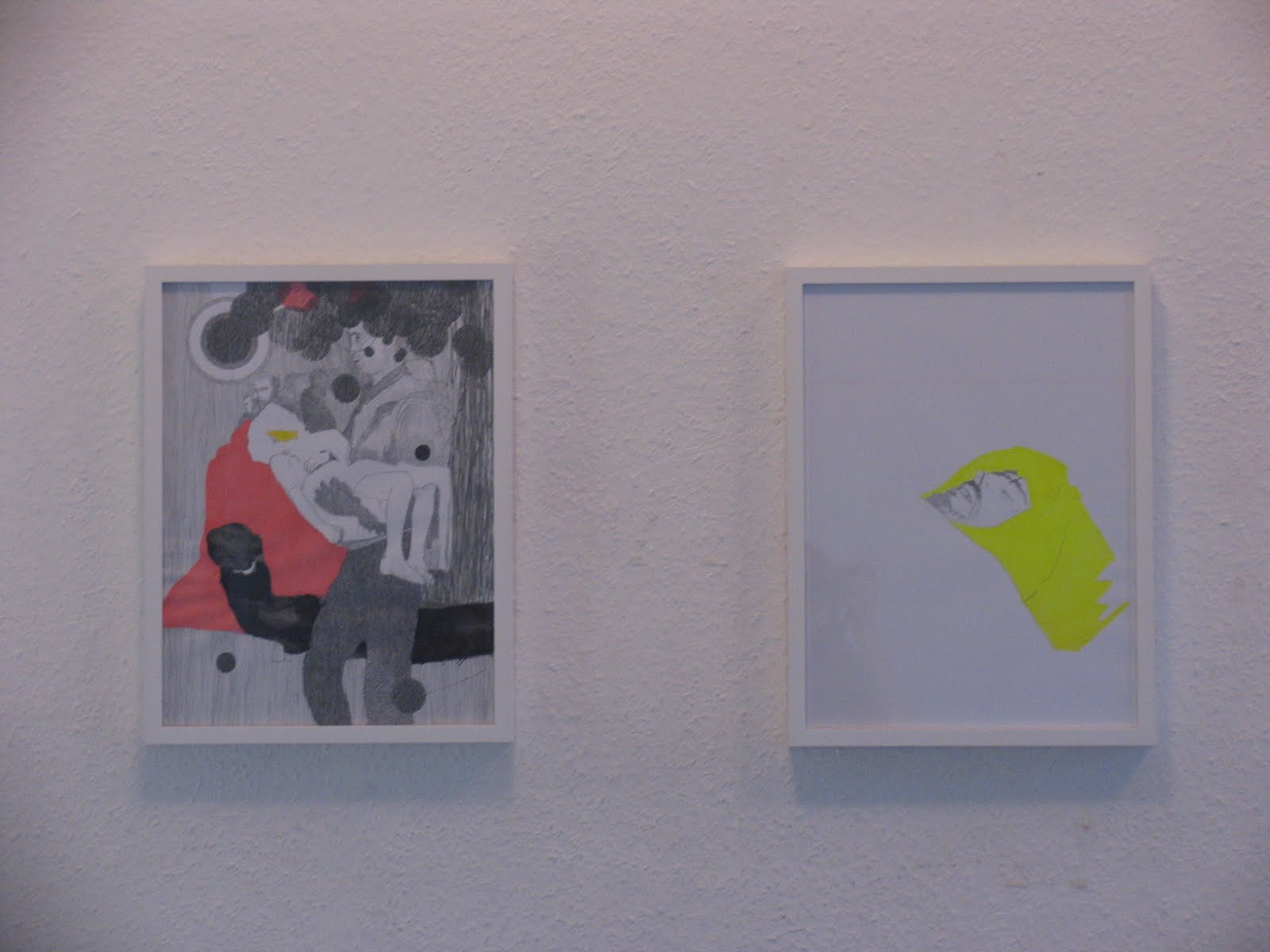
On the walls Dalila Bouzar's drawings on paper and canvas deal with the theme of war in Algeria. Although untitled, their visual innuendo is one of casualties, death, shootings and blood. In the second exhibition room the titles will reveal the work's message more overtly: Fraternite, Freiheitskämpfer.

Also in the second room, the artist's larger works (Flesh 2 and Flesh 3) will offer a change: both in technique (oil on canvas instead of pencil) and in their topic: the body and, maybe, love. This abstract display of large, light-coloured stripes matches the overall sobriety of her works.
Francesco Rozas not only inserts paradisiac images into the exhibition; he also literally lifts the exhibition space. A piece of the wooden floor has been raised a few centimeters above the ground, so that it now presents itself as a coffee table. The floor becomes a table, changes its function and reveals a bit of SAVVY's underground... The surface of the underground!
The gnome in front of the viaduct by Maryna Markova:
A blurry image, almost a shadow projected on a framed white surface.
The ambiguity of this work offers enough space for imagination, projection and… remembrance. While leafing through the exhibition catalogue (a very consistent little book encompassing a variety of texts: analyses, essays, interviews and reviews) I find out this work actually deals with a very material thing: the erasure of soviet memorials.

Another important element of this rather minimalist installation is the pile of big hard-covered books supporting the projector, hence the projection of the contourless image. Books as symbols of knowledge, these huge books as the basis of such a blurry image? I sense a mixture of irony and melancholy in this and I wonder if it's the same feeling that makes the other visitors linger around the work for while, looking at it, leaving and than coming back to it again.
And there is also the question: what kind of work is this? A photo? A dia-projection, an installation?
Memory I, II, III, IV:
Rebecca Loyche's 4 sound-video installations address the rhetorics of desire and loss, of memory and forgetting. Some discourses are longing and evocative, other wooing and provocative. A sense of incantation mixed with a feeling of protest fills this small exhibition space where speech is king: “Thank you, persistence”, “Thank you open windows and unlocked doors”, “constant consciousness and carnal craving”, “female perfection” and “intensity”, “thank you anxiety for keeping us all in check”... These are some of the words that accompany me home after visiting the exhibition.

the artist's hand: table on/off the floor
sunlight's hand: window on the floor
For a couple of days now Francisco Rozas' table sits upside down, topsy-turvy: its broken, fragile legs are waiting for the glue to bring them back to the ground. I must confess: it's very inspiring seeing things off the ground (and underground) at SAVVY... Here and now...
Sunday, May 15, 2011
Co-Lab Editions 2 at SAVVY Contemporary

Pants Konzepte
An event tailored by Ruth Feukoua and Serge Olivier Fokoua (Cameroon)
Curated by Marcio Carvalho
Wednesday, the 27th of April 2011
Have you ever been to an art performance and had your underwear tailored for you in the same time?
On Wednesday, the 27th of April 2011 the SAVVY Contemporary gallery in Berlin was pleased to offer its visitors this unique experience.
The performance conducted by the 2 Cameroonian artists was funny, playful and intimate: under the eyes of a simultaneously amused and shy public, they took their time and wrapped visitors' butts and waists in vividly coloured tape, thus tailoring individual pieces of underwear. Separated from their initial model, the emerging objects were placed in all their size and form on high pedestals and raised to the status of sculptures. Later that evening, driven by curiosity, some of us dared to touch the exhibited underwear. The electric colour of the tape added to their almost surreal appearance. Each pair of underwear, unique and lavishly resting on display, also brought a smile to the people passing by the gallery, who didn't witness the process of their creation and had no idea how the objects showed up there.
This performance has its roots in a long time collaboration between the curator and the 2 artists. At first there was an exchange of images and cityscapes from Berlin to Cameroon and the beginning of an inspired, creative process. Seeing people walk the streets of Berlin made the artists want to do the same... but in their own way. This is how they got the idea of walking through Berlin wearing an unusual outfit. Imagine two grown-ups wearing funny-looking, over-sized underwear walk through the city together with their daughter. The documentation of the whole process took the form of a video, which the visitors could watch at the gallery on the day of the performance.
Their daughter's presence brought a feeling of casualness to their strolling through Berlin. And it also fits the artistic credo of Ruth Feukoua and Serge Olivier Fokoua who like to work together as a family. This also goes back to another one of their performances, the one called Sharing love. This time the two partners washed each other's body and fed each other a special dish, as a sign of their mutual recognition and shared love in the creation of their daughter. During this performance Ruth Feukoua was actually pregnant, which brings real life and performance on the same level of experience. In an invisible manner, the child was also taking part in her parents' performance. And the viewer became a privileged witness of a very intimate moment that deals with creation, recognition and sharing.
This sense of intimacy, sometimes sensual, like in Sharing love, sometimes funny, like in Pants
Konzepte at SAVVY Contemporary is characteristic of their work. And also the idea of giving form to things that deeply inform our lives while remaining unseen.
The evening unfolded itself in 3 parts: the video-screening and the performance itself were complemented by a round discussion in the presence of the performers and the curator. The atmosphere was friendly and the topics ranged from performance art in Africa, its tradition and founding needs, the interference of the political regimes in the cultural life... The flow of the discussion originated in the fact that performance art is still new in Cameroon, with the invited artists being among the very few ones who choose it as a form of artistic expression. Their endeavour also materialized in a group of Cameroonian artists (Palettes of Kamer) who share the same interest in contemporary art and who value performance as one of its most powerful manifestations.
www.savvy-contemporary.com
http://co-labeditions.blogspot.com/
Wednesday, February 2, 2011
The Kafa princesses
Haimanut:
She came by, a grass straw in her mouth. I found her cool from the beginning, I must confess. Stage-friendly she was, carrying about the attitude of a born music performer.
Self-assertive, fresh and free, just like the grass she was playing with between her teeth. A bit nomadic, also, like an artist on the road, moving freely around the world. But I guess the genuine attitude of a child it's not to be so much analyzed. She caught my eye from the very first moment, which makes it a love-at-first sight encounter.
Branesh:
and there she was, all smiles and suns.
She attached to you immediately, trustfully and unconditionally. She was warm and bright, making her name real, being what she was called: Branesh=brightness.
She liked to strim the guitar, to look her guitar teacher in the eye and her gentle touch of the strings filled you with music.
Salamauit:
She was the 3rd in line in their family and the shiest. Maybe that is why she quietly enjoyed being photographed. Not being used to the camera and to attention focused on her alone, she would pose.
She and Branesh would slid under your clothes (huge socks and shoes, heavy boots, large caps), cheerfully playing around in your room. I always thought that carrying somebody's clothes is a sign of love. So I rejoiced in receiving their declaration, in knowing their love fits me like the best of clothes.
Burtican:
She was the defender of the family; the smallest, and therefore, the strongest. At the beginning she checked on us with such frowned eyes that we thought she were a boy, the only boy in the family, and therefore, their protector. At our next visit her face brightened up and her smile showed she now accepted and recognized us as friends. We were happy to know she gave us her accord to be there, in her home, with her family. From that day on she was no longer against us, but with us: feeding us, claping her hands, drumming on our songs, rejoicing in our presence. We were not tolerated in the sisters' home, we were loved.
We do not know how they could feel (sense) our presence when we would approach their house. Maybe it simply works like this with the persons you like. Fact is they would run to welcome us and, pulling us by the hands, draw us into their garden. Burtican, the strongest, would happilly climb down the ditch in front of the house, just to land in our arms. We then gloriously belonged to the Negatu girls.
It is said that if you carry a guitar with you, you will be king where ever you go. But what is a king without a kingdom? Our princesses would share their home, their kingdom with us.
She came by, a grass straw in her mouth. I found her cool from the beginning, I must confess. Stage-friendly she was, carrying about the attitude of a born music performer.
Self-assertive, fresh and free, just like the grass she was playing with between her teeth. A bit nomadic, also, like an artist on the road, moving freely around the world. But I guess the genuine attitude of a child it's not to be so much analyzed. She caught my eye from the very first moment, which makes it a love-at-first sight encounter.
Branesh:
and there she was, all smiles and suns.
She attached to you immediately, trustfully and unconditionally. She was warm and bright, making her name real, being what she was called: Branesh=brightness.
She liked to strim the guitar, to look her guitar teacher in the eye and her gentle touch of the strings filled you with music.
Salamauit:
She was the 3rd in line in their family and the shiest. Maybe that is why she quietly enjoyed being photographed. Not being used to the camera and to attention focused on her alone, she would pose.
She and Branesh would slid under your clothes (huge socks and shoes, heavy boots, large caps), cheerfully playing around in your room. I always thought that carrying somebody's clothes is a sign of love. So I rejoiced in receiving their declaration, in knowing their love fits me like the best of clothes.
Burtican:
She was the defender of the family; the smallest, and therefore, the strongest. At the beginning she checked on us with such frowned eyes that we thought she were a boy, the only boy in the family, and therefore, their protector. At our next visit her face brightened up and her smile showed she now accepted and recognized us as friends. We were happy to know she gave us her accord to be there, in her home, with her family. From that day on she was no longer against us, but with us: feeding us, claping her hands, drumming on our songs, rejoicing in our presence. We were not tolerated in the sisters' home, we were loved.
We do not know how they could feel (sense) our presence when we would approach their house. Maybe it simply works like this with the persons you like. Fact is they would run to welcome us and, pulling us by the hands, draw us into their garden. Burtican, the strongest, would happilly climb down the ditch in front of the house, just to land in our arms. We then gloriously belonged to the Negatu girls.
It is said that if you carry a guitar with you, you will be king where ever you go. But what is a king without a kingdom? Our princesses would share their home, their kingdom with us.
Subscribe to:
Posts (Atom)