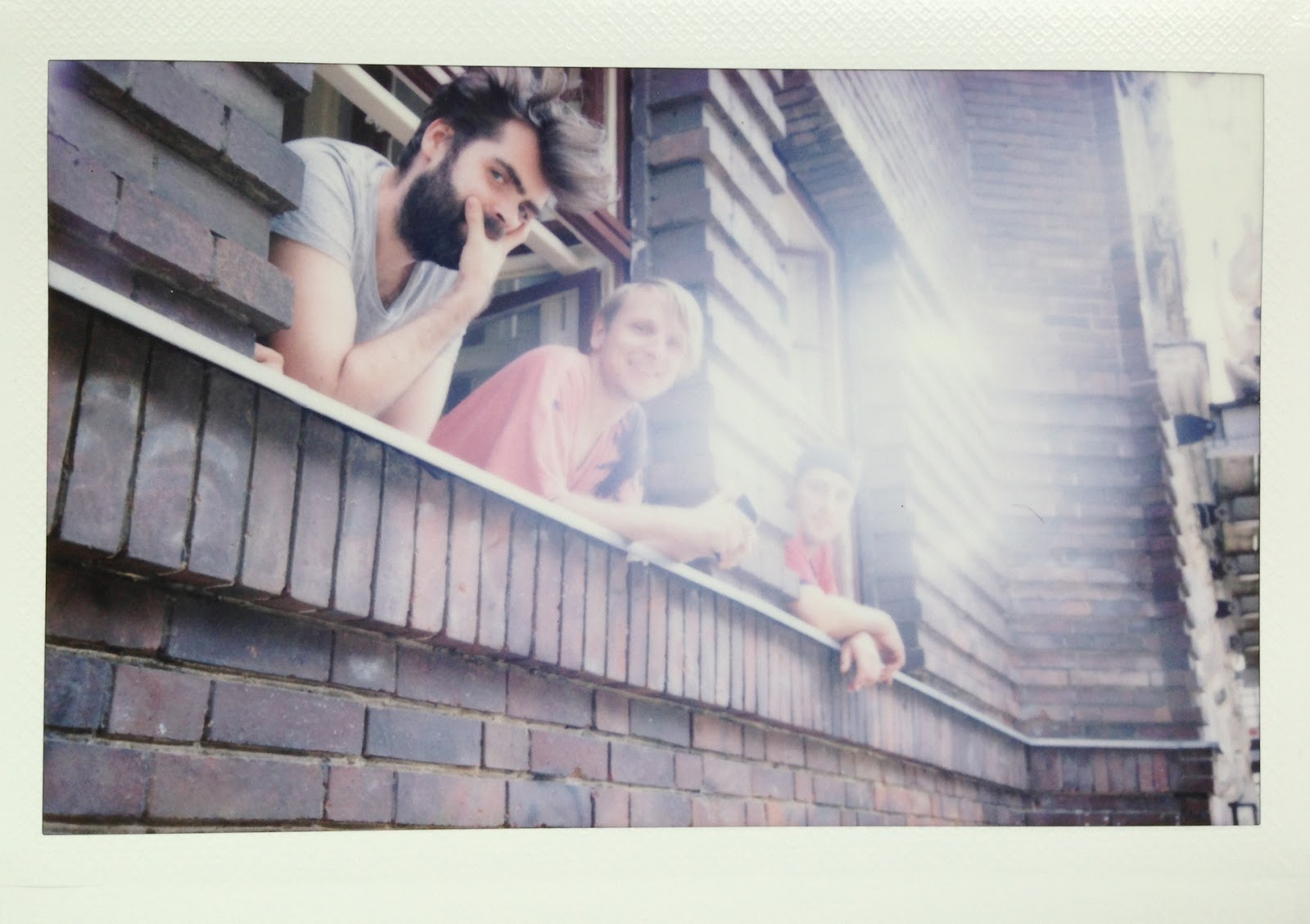
Vernissage: Friday, the 4th of October 2013, starting 7 PM
Exhibition: 5 October - 25 october 2013
Caffe degli Artisti, Fidicinstr. 44
Artists: Ioana Muntenescu (RO) & Daniel Lamas (DE/PE)
Curator: Claudia Lamas Cornejo
Management: Julia Goth
Tuesday, October 1, 2013
Thursday, September 12, 2013
Wednesday, September 11, 2013
Instant pictures in August
![]() |
| At Baretto, Wrangelstr. |
Visible, invisible, present...
![]() |
| Frieda Gabriella with Nora&Lars |
Saturday, August 10, 2013
II II // I
Nothings (and
Somethings) by Christian Burnoski
1st-14th August, 2013
with opening
performance To Be It by Andrea Jenni
with
Martina Cesari & MariaGiulia Serontoni
A black bowler hat
decorated with white buttons hiding a tennis ball... A white wall
framed by two perpendicular paintings, mainly orange, except for a
spot of white, where they meet the wall. Red stripes of the American
flag in a round frame and some missing stars, like the title overtly
states (Stripes without Stars, 2013). What you don't see and
exactly what you see lie in front of your eyes... Playful and
conceptual in the same time, Christian Burnoski's show in the attic
of Hochstr. 45 involves seeing, imagining, making-believe, believing.
Tennis Ball Under
Hat with White Buttons (2013) draws its inspiration from a scene
in Michelangelo Antonioni's Blow-Up (1966),
in which the camera follows an imaginary tennis ball... The presence
of the ball in Christian Burnoski's piece is a creation of both the
artist's and the viewer's powers of imagination. Due to their round
shape, the holes (like little nothings) in the canvases making up
Vine St. (2012) dialogue with the buttons from the near-by
magic hat. Playfulness is at the heart of this piece, too: the title
refers to the artist's address as a child and the holes nostalgically
encapsulate his “childhood phone number growing up” .
Vine St. 2012
holes cut in canvases, acrylic
Some of the
installations incorporate architectural elements of the exhibition
space itself: White Wall between Two Paintings mentioned
before and Echoes II, in
which the window is being doubled by paralleled pieces of
glass hanging on rope.
Echoes II, 2013
glass, rope, metal clasps, window
According to the artist's own confession, Between Two Infinite Voids (2013) encapsulates his view of life as a thin time span between two infinities (past and future), which makes it “the most existentialist piece in the exhibition”. When human life is a short, almost unsubstantial and invisible thing caught between before and after, the attempt to make it visible and to make it real resembles magic.
Andrea Jenni's
performance TO BE IT brings different rhythms in the exhibition
space. Alternating movement and stillness, dance and gesture, it
echoes Burnoski's play with juxtapositions, repetitions, reflections.
The opening of the performance installs a feeling of levitation and
slowness. Hit against the wall, two black latex balloons return to
the performers in a calm movement, almost floating. At the end of the
performance they will become exhibited objects and keep still in a
corner, between two wooden bearers (Inflatables in Space,
2013).
Inflatables in Space, 2013
latex balloons
During the second part
of the performance the two dancers, each of them in a different spot
of the exhibition place, perform slow motion movements in connection
with the black balloon. The last part involves dancing between Echoes
I and Echoes II (2013). The dancers' movements are more
rhythmical, they mirror and counterpoint each other, just like the
neighbouring art pieces.
Christian Burnoski's
exhibition and Andrea Jenni's accompanying performance engage in a
dialogue with the space and with each other. Out of their
collaboration the void and the Nothings became images of life and
invitations to play. Something worth seeing and sharing...
Exhibition views and performance stills: ©Ioana Muntenescu
II II // I Hochstraße 45, 13357 Berlin, www.hochstr45.com
Exhibition views and performance stills: ©Ioana Muntenescu
II II // I Hochstraße 45, 13357 Berlin, www.hochstr45.com
Sunday, July 28, 2013
Friday, June 28, 2013
Wonderlust during the 48-Stunden Neukölln Festival... and after!
The exhibition lasts until the end of June.
Opening hours: daily, from 6 PM... until the bartender decides to go home.
Many thanks to Frank and the Froschkönig: http://www.froschkoenig-berlin.de/
Wednesday, May 29, 2013
Mircea Cantor (b. 1977, Romania). Short notes on a personal discovery
I
discovered Mircea Cantor by chance, leafing through a French art
magazine. And I immediately liked his works. In the beginning it was
the UNPREDICTEBLE FUTURE: the handwriting on a
steamy, wet window. I think each of us has, at least once in his
life, put his finger on a dusty car or a steamy window, wrote
something and left there a short message. A message addressed to
everybody, to who ever happens to pass by and spot it.
In Mircea
Cantor's work the letters leave their traces as they start to melt,
before they will disappear. Letters: evanescent, living traces...
The
spelling mistake is charming and it made me think of a child having
written this on his way to school, home, to the playing ground, ...
through life.
A short
poem on fragility, evanescence, surprise, hope and the imagination.
The artist
is renown for his film entitled Deeparture, in which a wolf
and a deer were brought in a white, empty gallery and left to watch
each other, make each other nervous and unsettle our own senses and
expectancy. The tension surfaces from challenging the instincts, from
the crude beauty of bringing together two creatures which in a
different environment (their natural one) are destined to play the
roles of pray and hunter. The viewer of this film witnesses the
exchange of glances between the wolf and the deer, their breathing,
restlessness and calm.
This is a
simple, almost minimalist film. Bringing together the two animals is
a challenge Mircea Cantor addresses to death and survival instincts
(both violent and fully natural) and it is also an invocation of the
unexpected. Things no longer happen according to a preconceived
scenario.
When I
read in his CV that he lives ”on Earth” I remembered
another work, also made in a minimalist manner, namely by adding a
single letter: the French title Le Monde becomes for Mircea
Cantor Les Mondes. The critics read in this an
anti-globalisation message; I rather see it as a small manifesto of
freedom, an apparently simple game, with letters and a marker: the
artist-child and the artist-protester play with the world, correct
it, complete it. The artist’s toy, the world, becomes a multitude
of toys (les mondes). There is a Dadaist feeling in his work,
drawing back to the Romanian inception of modern art.
In
a video entitled The Landscape
is Changing a
group of protesters
carry
mirrors
instead of banners with slogans. In their mirrors you see how the
environment changes while the people themselves walk and change their
position. As the artist himself confesses, he is interested not in a
global discourse, but rather in a universal one. The
protest takes places in an unknown city, no words are written
anywhere, there are only people and the world they transform. The
image (the reflection in the mirror, the video itself) mediates
between us and the world.
Although
The Title is the Last Thing,
(Philadelphia Museum of Art, 2006), I confess I like Mircea Cantor’s
titles: Changing Sky
(Ciel Variable, Frac,
Champagne-Ardenne, Reims, 2007),
Born to be Burnt
(GAMeC, Bergamo, 2006). Works such as The
Second Step and Double-Heads
Matches raise
my good spirits: a double-headed match is a sign that the world keeps
on being reinvented.
The
second step: is it Armstrong’s second step on the moon, taken
out of anonymity by the artist or does it belong to another lunatic
astronaut? In both cases, it is a fresh, cheerful and optimist
imprint upon the open world we live in.
I
like Mircea Cantor’s humour: regarding the for or against
discourse on globalisation, he brings in a mischievous smile: ”I
hear a lot of this official, left-winged discourse about the
periphery. Berlin, Los Angeles... I myself came to live in Paris in
order to be at the periphery of Romania. It’s my manner of keeping
a distance from everything.
(”J'entends beaucoup ce discours
officiel, de gauche, sur les peripheries. Berlin, Los Angeles...
Moi-meme, je suis venu habiter a Paris pour vivre a la peripherie de
la Roumanie. C'est ma maniere d'avoir une distance avec tout”,
Beaux Arts,
No.275, May 2007). The artistic credo of a man living in exile, but
”on Earth”.
Tuesday, February 26, 2013
Spring is on ity way!...
You are kindly invited!
Poster-invitation done by Chiara Bonetti, using one of my photos. Mille grazie!
Please visit her work here: http://www.chiarabonetti.com/
Labels:
Ioana Muntenescu,
Where is Jesus Cafe,
Wonderlust
Friday, February 1, 2013
Latifa Sayadi: A twist of iron(y)
![]() |
| Genetically manipulated something, 2007 |
Latifa Sayadi's metal sculptures have a playful character: entanglements, twists and foldings of the material are paired with word-plays and innuendos. Conceived as individual pieces or as series, Latifa Sayadi's works re-enact a situation, express a state of mind, suggest a human form. Although she defines her works as abstract sculptures, their focus doesn't lie in virtuosities and stylization of the form. What makes them abstract is their poetic and often ironic interpretations of reality.
Done in various
materials, her sculpture surprises by the way one material meets the
other, one brass detail fits within the body of the steel.
Nevertheless, the sculptures don't work by contrast, but by surprise.
Sayadi's art is not an attempt to gain an effect, but to express and
trigger a discovery. In her view, balance is a zigzagging flight of
stairs (Equilibre, 2012) and craziness can dis-place and
display a “heart” of gold (Verrückt) .
![]() |
| Verrückt (detail) |
While some of the single sculptures are built around a defining detail, the series play with the idea of reality and its multiple perspectives (Lonesome Tragedy and Lonesome Comedy). But the artist is not fixed on binary situations and the serial character of her work is a playful and insightful attempt to catch the richness of life (see Expression, Impression, Depression).
![]() | ||
| Lonesome Tragedy, 2007 |
Latifa Sayadi's playing ground is quite large: besides sculpting metal she also makes installations and etchings. While the forged metal sculptures carry the memory of fire and noise which accompanied their coming into form, the etchings put forward a certain quietness and delicacy. In her installations, born out of a desire to react to and interpret real events which caught her attention, the evocative power of the chosen materials is reinforced by the works' titles (Immigrants leaving traces or Rue de l'Impasse). Be it personal experiences or serious political themes (such as immigration, land poisoning through bomb dropping, re-installation of dead-end regimes), her subject matter is always treated with a twist of irony.
![]() |
| Dictature globale, 2012 |
![]() |
| Immigrants leaving traces, 2011 |
The text was first published in: Latifa Sayadi, catalogue, simpact, Tunis, 2013.
Photos: ©Stefanie Gierke, Latifa Sayadi, Holger Ziefus (for the sculptures); ©Joerg Kretschmann (for the etchings).
Please visit Latifa Sayadi's website: www.schmiedin.de
Tuesday, January 1, 2013
Die bewegende Welt: die reale Rahmung jedes Fotos
Pieter Hugos großformatige Fotografien aus der Permanent Error Serie sind Einzel- oder Gruppen-Porträts und Landschaftsaufnahmen von einer Schrottplatz für Elektromüll in Ghana, der lokal auch unter dem Namen Sodom und Gomorrha bekannt ist. Jungen auf der Suche nach wiederverwendbaren Teilen, umgeben von großen, grauen Asche- und Giftwolken und orangen Feuern; am Ort liegende Kühe mit zwei laufenden menschlichen Figuren im Hintergrund. Es gibt Bilder der Arbeit, die sich der Atmosphäre eines Infernos annähern, und Bilder der Ruhe, wie zum Beispiel das eines Arbeiters beim Schlafen.
Durch mein Studium der afrikanischen Kunst war mir das Werk von Pieter Hugo (geb. 1976, Südafrika) schon bekannt, wie zum Beispiel die Serien Nollywood und The Hyena and Other Men (die ihn 2007 bekannt gemacht hat). Ein paar von seinen Stil-Charakteristika sind auch in der aktuellen Ausstellung wieder zu erkennen: eine präzise Inszenierung des Porträts; sein Interesse an Außenseitern und der Versuch, ihren Lebensstil zu dokumentieren (wie bei der Hyena and Other Men Serie); eine ästhetizierende Wirkung (eine Art slum-coolness in diesem Fall); die Ambivalenz seiner Bilder, gleichzeitig reell und surreal, faszinierend und störend.
Ich wusste ein bisschen was mich in der Ausstellung erwartet: die schon erwähnte “apocalyptic Vision“ und “die dahinter stehende ethische Fragestellung zu unserem rapiden Umgehen mit Technik“ (http://thephotographersgallery.org.uk/pieter-hugo). Irgendwie hatte ich Angst, dass das ganze Projekt nur bei dieser Ebene bleibt. Ich kam zur Ausstellung um den Künstler abzuchecken, gebe ich zu. Nach meinem Besuch, haben seine Fotos mich überzeugt, dass sie mehr als sensationell und störend sind. Über diese persönliche Entdeckung möchte ich euch erzählen.
Für mich waren die Videos das Unerwartete in seiner Ausstellung. Jeder der drei Fernseher, die sich am Eingang des ehemaligen Turnsaals befinden, zeigt einen Jungen der versucht vor der Kamera eine Weile still stehen zu bleiben. Hinter ihm arbeiten seine Kollegen weiter, ganz ungestört und der Rauch von den brennenden Materialien hebt sich ab. Am Anfang bist du dir ganz nicht sicher, ob du ein slow-motion Video oder ein Bild betrachtest.
Mit ihren überlagerten Tempos (Kino und Foto in einem), mit ihrem Spiel zwischen Vor- und Hintergrund wirken Pieter Hugos Videos wie entfaltete und verlängerte Fotoschüsse. Ihre Protagonisten erkennen wir schon aus den Bilder an der Wand und es ist als ob wir Zeugen bei der Entstehung der Fotos werden. Die Frage stellt sich: wie wurden dann die Porträts aufgenommen? Mussten die Jungen lange still bleiben, wie Exponate in einem Museum oder in einer ethnographischen Ausstellung? Die Videoarbeiten stellen die Stärke und die Schwäche der Fotografie in Frage. Wie z. B den fast unmenschlichen Versuch, eine Person auf dem Stillstand zu halten, sie in ein unbewegtes Objekt zu verwandeln.
Die Stärke dieser Bilder besteht auch darin, dass sie gleichzeitig Spannung und Stille erzeugen können, Coollness und Ausdauer. Es gibt etwas Berührendes in der langen Pose des Junges der versucht, die große Ladung auf seinem Kopf im Balance zu halten. Uns wird es wieder bewusst: ein Foto zu machen ist ein Prozess, die Fotografie braucht und handelt mit der Zeit. Und noch mehr: die Fotografie bringt die Welt zum Stillstand. Die Videos offenbaren eine Verbindung zwischen dem Leben, das immer in Bewegung ist, und dem Foto, das aus diesem Fluss des menschlichen Agierens entnommen ist.
Wir gucken uns die unerschrockenen, eifrigen Protagonisten an, die lange still bleiben können, während der Hintergrund weiter läuft. Das Individuum und die Welt. Was ist die Verbindung zwischen dem Still-Bild und der Welt, die reale Rahmung jedes Fotos? Wo kommen wir, als Zuschauer, ins Spiel?
Die Permanent Error Serie setzt sich mit brisanten Themen, wie Globalisierung, Verwendung von Technik und Verschwendung auseinander und liefert dadurch eine Meditation über unsere Welt und unser Leben. Die Bilder zeigen Kontraste und damit werden auch Verbindungen aufgedeckt. Mit ihrem Fokus auf von kaputten Computern umgebenen Individuen, können die Fotos von Hugo auch als ein Zelebrieren des Lebens verstanden werden.
Noch kurz zum Schluss: die Fotos von Pieter Hugo befinden sich in der guten Begleitung der poetischen Bilder und Kleinvideoaufnahmen von Rinko Kawachis. Durch ihre Werken gelingt es beiden Künstlern uns eine Meditation über Dauer, Ausdauer und Lebenszeit anzubieten.
Pieter Hugo im C/O Berlin: 10. November 2012 - 13. Januar 2013
http://www.co-berlin.info/programm/exhibitions/2012/deutsche-boerse-photography-prize.html
Alle Bilder im Text: ©Pieter Hugo. Mit freundlicher Genehmigung von Stevenson, Cape Town and Yossi Milo, New York
Text erschienen auch auf artiberlin.de http://www.artiberlin.de/article/Die_bewegende_Welt_die_reale_Rahmung_jedes_Fo
Weiter, in dem großzügigen Raum der ehemaligen Turnhalle trifft man zuerst auf Yakuba Al Hasan: eine volle Ladung Kabel krönt seinem Kopf, auf der linken Schulter trägt er einen Reifen. An der Wand gegenüber steht das Bild von dem kleinen, schüchternen und ernst blickenden Mädchen Naasra Yeti in einer hochzeitsähnlichen Kleidung. Der Junge Al Hasan Abukari ist auch Teil der Porträtierten und sein türkisfarbenes T-shirt zeichnet ihn vor dem grauen Hintergrund deutlich ab.
Durch mein Studium der afrikanischen Kunst war mir das Werk von Pieter Hugo (geb. 1976, Südafrika) schon bekannt, wie zum Beispiel die Serien Nollywood und The Hyena and Other Men (die ihn 2007 bekannt gemacht hat). Ein paar von seinen Stil-Charakteristika sind auch in der aktuellen Ausstellung wieder zu erkennen: eine präzise Inszenierung des Porträts; sein Interesse an Außenseitern und der Versuch, ihren Lebensstil zu dokumentieren (wie bei der Hyena and Other Men Serie); eine ästhetizierende Wirkung (eine Art slum-coolness in diesem Fall); die Ambivalenz seiner Bilder, gleichzeitig reell und surreal, faszinierend und störend.
Ich wusste ein bisschen was mich in der Ausstellung erwartet: die schon erwähnte “apocalyptic Vision“ und “die dahinter stehende ethische Fragestellung zu unserem rapiden Umgehen mit Technik“ (http://thephotographersgallery.org.uk/pieter-hugo). Irgendwie hatte ich Angst, dass das ganze Projekt nur bei dieser Ebene bleibt. Ich kam zur Ausstellung um den Künstler abzuchecken, gebe ich zu. Nach meinem Besuch, haben seine Fotos mich überzeugt, dass sie mehr als sensationell und störend sind. Über diese persönliche Entdeckung möchte ich euch erzählen.
Für mich waren die Videos das Unerwartete in seiner Ausstellung. Jeder der drei Fernseher, die sich am Eingang des ehemaligen Turnsaals befinden, zeigt einen Jungen der versucht vor der Kamera eine Weile still stehen zu bleiben. Hinter ihm arbeiten seine Kollegen weiter, ganz ungestört und der Rauch von den brennenden Materialien hebt sich ab. Am Anfang bist du dir ganz nicht sicher, ob du ein slow-motion Video oder ein Bild betrachtest.
Mit ihren überlagerten Tempos (Kino und Foto in einem), mit ihrem Spiel zwischen Vor- und Hintergrund wirken Pieter Hugos Videos wie entfaltete und verlängerte Fotoschüsse. Ihre Protagonisten erkennen wir schon aus den Bilder an der Wand und es ist als ob wir Zeugen bei der Entstehung der Fotos werden. Die Frage stellt sich: wie wurden dann die Porträts aufgenommen? Mussten die Jungen lange still bleiben, wie Exponate in einem Museum oder in einer ethnographischen Ausstellung? Die Videoarbeiten stellen die Stärke und die Schwäche der Fotografie in Frage. Wie z. B den fast unmenschlichen Versuch, eine Person auf dem Stillstand zu halten, sie in ein unbewegtes Objekt zu verwandeln.
Die Stärke dieser Bilder besteht auch darin, dass sie gleichzeitig Spannung und Stille erzeugen können, Coollness und Ausdauer. Es gibt etwas Berührendes in der langen Pose des Junges der versucht, die große Ladung auf seinem Kopf im Balance zu halten. Uns wird es wieder bewusst: ein Foto zu machen ist ein Prozess, die Fotografie braucht und handelt mit der Zeit. Und noch mehr: die Fotografie bringt die Welt zum Stillstand. Die Videos offenbaren eine Verbindung zwischen dem Leben, das immer in Bewegung ist, und dem Foto, das aus diesem Fluss des menschlichen Agierens entnommen ist.
Wir gucken uns die unerschrockenen, eifrigen Protagonisten an, die lange still bleiben können, während der Hintergrund weiter läuft. Das Individuum und die Welt. Was ist die Verbindung zwischen dem Still-Bild und der Welt, die reale Rahmung jedes Fotos? Wo kommen wir, als Zuschauer, ins Spiel?
Die Permanent Error Serie setzt sich mit brisanten Themen, wie Globalisierung, Verwendung von Technik und Verschwendung auseinander und liefert dadurch eine Meditation über unsere Welt und unser Leben. Die Bilder zeigen Kontraste und damit werden auch Verbindungen aufgedeckt. Mit ihrem Fokus auf von kaputten Computern umgebenen Individuen, können die Fotos von Hugo auch als ein Zelebrieren des Lebens verstanden werden.
Noch kurz zum Schluss: die Fotos von Pieter Hugo befinden sich in der guten Begleitung der poetischen Bilder und Kleinvideoaufnahmen von Rinko Kawachis. Durch ihre Werken gelingt es beiden Künstlern uns eine Meditation über Dauer, Ausdauer und Lebenszeit anzubieten.
Pieter Hugo im C/O Berlin: 10. November 2012 - 13. Januar 2013
http://www.co-berlin.info/programm/exhibitions/2012/deutsche-boerse-photography-prize.html
Alle Bilder im Text: ©Pieter Hugo. Mit freundlicher Genehmigung von Stevenson, Cape Town and Yossi Milo, New York
Text erschienen auch auf artiberlin.de http://www.artiberlin.de/article/Die_bewegende_Welt_die_reale_Rahmung_jedes_Fo
Monday, December 31, 2012
The moving world: the real frame of every photo
Pieter Hugo's Permanent Error Series in C/O
Berlin
10 November 2012 - 13 January 2013Housed by C/O Berlin the exhibition of the 4 finalists of the Deutsche Börse Photography Prize 2012 offers an insight into the development of contemporary photography. John Stezaker's miniature photos and ironic collages, Pieter Hugo's imposing portraits, Rinko Kawauchi's visual dairy with revelations of the everyday life and Christopher Williams' interrogation of our modern use of media, all question the medium of photography itself and try to open new perspectives upon it.
Pieter Hugo's big format photos from the Permanent
Error Series are single- or group-portraits and landscape
pictures taken on Agbogbloshie Market, a large damping ground for
technological waste on the outskirts of Accra (Ghana), a place
locally known as Sodom and Gomorrah. Young men looking for reusable
materials, surrounded by grey ash-clouds and smoky orange fires. Cows
resting on the damping place, facing the viewer, while somewhere in
the background two human figures are walking across the field,
carrying found material. There are photos of work, where the
photographer's eye catches the inferno-like atmosphere of the place,
and there are also photos of rest, like that of a workman sleeping.
This closer point of view upon the sleeping person adds an intimate
note to this series in which most of the protagonists are shown from the
front and in full body.
![]() |
| Untitled, Agbogbloshie Market, Accra, Ghana 2010 |
On entering the generous space of the former gym hall you first encounter Yakuba Al Hasan: a whole bundle of cables crowns his head, on the left shoulder he carries a tire. On the opposite wall there is the photograph of the little girl Naasra Yeti, a bit worried, a bit shy, serious-looking in her wedding-like dress. The young Al Hasan Abukari is also among the photographed workers and his turquoise T-shirt seems to mark him out against the grey background of ash and fire.
![]() |
| Yakubu Al Hasan, Agbogbloshie Market, Accra, Ghana 2009 |
![]() |
| Naasra Yeti, Agbogbloshie Market, Accra, Ghana 2009 |
Through my African studies I was a bit familiar with the work of Pieter Hugo (b. 1976, South Africa), such as his Nollywood series and the The Hyena and Other Men, 2007 (which made him famous). Some of the main characteristics of his style are also visible here: a precise staging of the portrait; his interest for outsiders and the attempt to document their way of life (such as with the Hyena men before); an aestheticizing effect (a sort of slum-coolness in this case), the ambivalent quality of his images, real and surreal in the same time, fascinating and disturbing.
I knew a little what to expect: “the apocalyptic
vision” pointed out by critics, the photographer's “questioning
of the ethics of our rapid consumption of ever-new technology and its
hidden consequences”1.
Somehow I was afraid the whole project would stay within these lines.
I came to the exhibition to check up on Hugo a little, I confess.
After seeing them, his photos convinced me they
go beyond the sensational and the disturbing. It is this
discovery I would like to tell you about.
To me, the unexpected element in Pieter Hugo's show at C/O Berlin are his videos. Each of the 3 TV-sets at the entrance to the former sport hall shows a young man (from the collectors of technological waste) trying to keep still in front of the camera for quite some time; behind the posing man, his colleagues go on with their work, undisturbed and smoke keeps on rising from the burning discarded material. At the beginning you don't even realize what it is you are actually watching: a slow motion video or a photograph.
Juxtaposing two tempos (cinema and still-image in one)
and playing with the notions of foreground and background Pieter
Hugo's videos are like unfolded, prolonged photos. We recognize their
protagonists form the pictures hanging on the wall and it is as if we
are witnessing the making of the photograph. The question rises in
our mind: how were the photos taken? did the protagonists have to sit
still for a long while, like exhibits in a museum or in an
ethnographic show? Through his videos, Hugo questions the virtues and
weaknesses of photography itself. Like its almost inhuman attempt to
make a person keep still, turn her into a non-moving object.
The strength of these videos resides in the way they
simultaneously convey tension and stillness, coolness and endurance.
There is something touching and fascinating in the long posing of the
young man trying to keep the load on his head in balance. We have
been remembered now: photography is a process and it takes time. And
photography also brings the world to a still stand.
Thus, Hugo's videos reveal a connection between life,
which is always moving, and the photograph, which is extracted from
this continuous flow of human action.
We watch Pieter Hugo's unflinching, diligent
protagonists keep still while the background keeps on moving. The
world and the individual. What is the relationship between the
still-image and the world, the actual frame around every photo? Where
do we, as viewers, intervene?
Addressing timely
issues regarding globalization, consumption, waste,
Permanent Error is also a meditation on our world, on life. By
stressing out contrasts, his images also reveal connections. And,
focusing on individuals surrounded by non-functional computers,
Hugo's photos can also feel like a celebration of life.
To conclude: At C/O Berlin Pieter Hugo's images are in
the good company of Rinko Kawauchi's poetic photos and short videos
(Illuminance). With their works both artists offer us a
meditation on duration, endurance and lifespan.
All images in the text: ©Pieter Hugo. Courtesy of Stevenson, Cape Town and Yossi Milo, New York
They can also be viewed at:
www.pieterhugo.com
The exhibition review first appeared online at:
http://thenleleinstitute.wordpress.com/photography-in-africa-by-ioana-muntenescu/
Many thanks to Uche Okpa-Iroha for the publication.
Notes:
1http://thephotographersgallery.org.uk/pieter-hugo
(last accessed: 27 November 2012).
Wednesday, November 21, 2012
echos-Abschlussausstellung der Ostkreuzschule für Fotografie 2012
Fotografien von 20 Absolventen finden, über 3
Stockwerke und selbst im breiten Dachgeschoss verteilt, genug Freiraum,
um ihren sehr eigenen Charakter zu entfalten.
Beim Betrachten fühle ich mich, als ob ich an einem Tag 20 neue Persönlichkeiten mit ihren eigenen Perspektiven, Interessen, Bestrebungen und Ideen kennenlernen kann. 20 neue Welten.
Jede Bilderserie ist autonom und stark, jede Fotografin und jeder
Fotograf hat etwas mitzuteilen, durch das Medium der Fotografie.
Eine Verbindung: zwischen Tochter und Mutter (Zuzanna Kaluznas Sag mir, wer ich nicht bin); zwischen leeren Gerichtshöfen und den Menschen, die nicht da sind (Mark Alker Fiat iustitia, et pereat mundus); zwischen Nachbarn in einer verlassenen Nachbarschaft in Pittsburg, USA (Hanna Fuhrmann The 800 Block).
Zwischen großen, schwer zu durchschauenden Waldansichten in
schwarz-weiß und vielleicht, dem farbigen, urbanen Rest der Welt in Eric Meiers Aporia.
Sei es sozial engagiert oder ästhetisch fokussiert, im Ausland oder
in die eigene Vergangenheit gereist, Objekte betrachten oder Menschen
bei Alltäglichem beobachten; jedes fotografische Projekt ist eine
Entdeckung!
Echos mutet wie ein akustisch konnotierter Titel an. Für diese Ausstellung ist er dennoch aufschlussreich, da die Bilder hier auch kling
um die Sprache, sondern darum Eindrücke, Gefühle und Gedanken hervorzurufen.
Manchmal auch darum Vergangenheit und Gegenwart miteinander zu
verbinden, um den Versuch, das historische Geschehen im Einklang mit der
Familiengeschichte zu bringen, wie in Ulrike Schmitz' Fotos aus der Serie Museum deiner Erinnerung.
Die Bilder weisen eine bewusste, stark artikulierte visuelle Sprache
aus. Die Fotografie wird verstanden und benutzt, nicht nur als Sprache,
deren Technik man beherrschen muss, sondern ebenso als atmosphärisches
Medium, als Wiederkehr einer Realität, als visuelles Echo. Im besten
Fall kann der Betrachter in diesem Sinne als Echo wirken, das die Stärke
der Bilder und Geschichten mitnehmen.
Bilder im Text:
Bild 1: © Birte Kaufmann
Bild 2: © Isabel Kiesewetter
Text erstmals auf artiberlin erschienen: http://www.artiberlin.de/article/echos-Abschlussausstellung_Ostkreuzschule_5_E
Vielen Dank der artiberlin Redaktion!
Subscribe to:
Posts (Atom)


.jpg)